
The Ultimate Guide to Software Development Services
Every growing business eventually reaches a point where spreadsheets, generic tools, and manual workflows simply cannot keep up. That is usually the moment leaders start searching for real software development services. Whether the goal is automating operations, launching a customer facing application, or modernizing an aging system, the right technology partner can transform how a company operates. This guide walks through what software development services actually include, why they matter, and how to choose a partner who can deliver lasting value.

Software development services cover the full process of designing, building, testing, and maintaining digital solutions tailored to a business. Companies invest in custom software to gain efficiency, security, and a competitive edge that generic tools cannot offer. This guide explains the core service types, the development process, and a practical framework for choosing the right partner.
Software development services are the end to end professional processes a company uses to plan, design, build, test, deploy, and support digital applications. This includes custom software development, enterprise software, web and mobile applications, cloud based systems, API development, and ongoing maintenance. A professional software development company acts as a technology partner, aligning engineering decisions with business goals rather than simply writing code.
Off the shelf tools are built for the average user, not for a specific business. As companies scale, they often outgrow generic platforms and face limitations around integration, security, and reporting. Custom software is built around actual workflows, which means fewer workarounds, better data accuracy, and systems that grow alongside the organization instead of holding it back.
Quick Facts
- Custom software typically reduces manual process time significantly within the first year.
- Cloud based architecture allows systems to scale without major infrastructure investment.
- Security built in from day one is far more effective than security added later.
Native and cross platform apps that extend business capability to phones and tablets for both customers and field teams.
Applications hosted on scalable cloud infrastructure, reducing hardware costs while improving uptime and accessibility.
Connecting existing tools, databases, and third party platforms so information flows automatically instead of being entered twice.
Updating legacy systems with modern architecture, improved security, and better performance without losing critical business data.
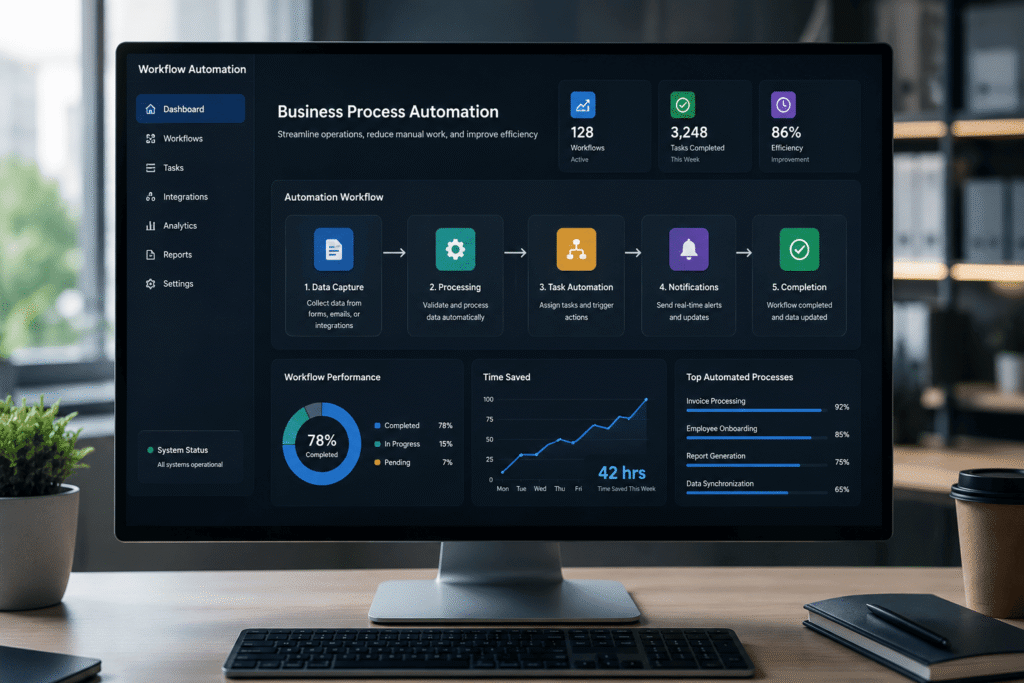
Replacing repetitive manual tasks with automated workflows that save time and reduce human error.

Adding machine learning and AI powered features such as predictive analytics, intelligent automation, and smart recommendations.
Building authentication, encryption, and compliance controls directly into the architecture rather than treating security as an afterthought.
Designing systems that can handle growth in users, data, and features without requiring a full rebuild.
Expert Tip
- A technology partner should always ask about your business goals before recommending a technology stack. If a company jumps straight to tools and frameworks, that is a warning sign.
Understanding business goals, user needs, and technical constraints before any code is written.
Designing the system structure, database, and technology stack around scalability and security.
Creating user experience and interface designs that are intuitive for the people who will actually use the software.
Writing and building the application in structured, testable increments rather than one large release.
Verifying functionality, performance, and security through multiple rounds of testing before launch.
Releasing the software into a live environment with monitoring in place from day one.
Ongoing updates, bug fixes, and improvements that keep the software secure and aligned with changing business needs.
| Phase | Typical Duration |
|---|---|
| Discovery and planning | 2 to 4 weeks |
| Design and architecture | 3 to 6 weeks |
| Core development | 8 to 16 weeks |
| Testing and refinement | 3 to 5 weeks |
| Launch and support | Ongoing |
Professional software development delivers measurable business value. It improves operational efficiency by automating manual work, strengthens security through proper architecture, and gives leadership better visibility through accurate reporting. Custom solutions also scale with the business, meaning the same platform can support ten employees or ten thousand without a complete redesign. Perhaps most importantly, custom software becomes a genuine competitive advantage since competitors cannot simply buy the same off the shelf product.
| Factor | Custom Software | Off the Shelf Software |
|---|---|---|
| Fit to business needs | Built around actual workflows | Generic, one size fits all |
| Scalability | Grows with the business | Often limited by licensing tiers |
| Integration | Connects easily with existing tools | May require workarounds |
| Ownership | Business owns the solution | Vendor controls the product |
| Long term cost | Higher upfront, lower over time | Lower upfront, recurring fees add up |
| Security | Tailored to specific risk profile | Shared across all users of the product |
| Business Challenge | Software Solution |
|---|---|
| Manual, repetitive tasks | Business process automation |
| Disconnected tools and data | API integration and centralized platforms |
| Limited visibility into performance | Custom dashboards and analytics |
| Outdated legacy systems | Software modernization |
| Growing customer base | Scalable cloud based architecture |
| Security and compliance concerns | Built in software security controls |
Most business problems come down to information not moving efficiently or people spending time on tasks a system could handle automatically. Well designed software closes that gap. It centralizes data so teams are working from the same accurate information, automates the repetitive parts of a process, and gives leadership the reporting needed to make faster, better informed decisions.
Healthcare, finance, retail, logistics, manufacturing, real estate, and professional services all rely heavily on custom software today. Each industry has unique compliance requirements, workflows, and customer expectations, which is exactly why generic tools tend to fall short and purpose built systems perform so much better.

Decision Making Framework
- Review their portfolio and case studies in your industry.
- Ask about their development process and communication style.
- Confirm they prioritize security and follow best practices.
- Evaluate their approach to long term maintenance and support.
- Make sure they take time to understand your business goals, not just your technical requirements.
A reliable technology partner communicates clearly, explains technical decisions in plain language, and treats your business goals as the starting point for every recommendation. Be cautious of any company that offers a quote before fully understanding your needs.
Business Readiness Assessment
- Do you have a clear list of the problems you want software to solve?
- Do you know which systems the new software needs to integrate with?
- Have you identified who will use the software day to day?
- Do you have a realistic budget and timeline in mind?
- Is leadership aligned on the priority of this investment?
Many businesses choose the cheapest vendor rather than the most capable one, skip proper discovery and planning, or underestimate the importance of ongoing maintenance. Others try to replicate every feature of a competitor’s software instead of focusing on what actually solves their own problems. Avoiding these mistakes early saves significant time and money later.
Artificial intelligence, low code platforms, and cloud native architecture continue to reshape how software is built. Businesses that invest in scalable, secure, and future ready systems today will be far better positioned to adapt as these trends accelerate, rather than facing another costly overhaul in a few years.
Frequently Asked Questions
- Software development services help businesses automate work, scale efficiently, and stay secure.
- Custom software is built around real workflows, unlike generic off the shelf tools.
- A proper development process reduces risk and improves long term outcomes.
- Choosing the right technology partner is one of the most important decisions a growing business will make.
Investing in professional software development is no longer optional for businesses that want to remain competitive. The right solution, built by the right partner, becomes a long term asset that supports growth rather than limiting it. If your business is ready to move beyond generic tools and manual workarounds, now is the time to start the conversation.
Ready to Build Your Digital First Strategy?
From custom software and web development to AI solutions and business automation, Devloria helps businesses become future ready. Let's talk about what a realistic roadmap looks like for you.
Schedule a Consultation