
How AI Is Revolutionizing the Software Development Industry in 2026
Software teams today work differently than they did even two years ago. Artificial intelligence now sits inside the code editor, the testing pipeline, and the planning process, and it is changing how software gets built. For business owners and technology leaders, the question is no longer whether AI belongs in software development. It is how to use it well.
Our team works with organizations modernizing legacy systems, building new digital products, and trying to understand what AI means for their next project. This report explains what is really happening in 2026, where AI creates genuine value, where human judgment still matters most, and how a business can approach adoption without getting swept up in hype.
Quick Answer
At a Glance
- AI is changing software development by speeding up coding, testing, documentation, and code review.
- The greatest value shows up in repetitive and pattern based tasks.
- AI is not replacing skilled developers. It is changing what they spend their time on.
- Businesses that treat AI as a tool guided by experienced professionals see the strongest results.
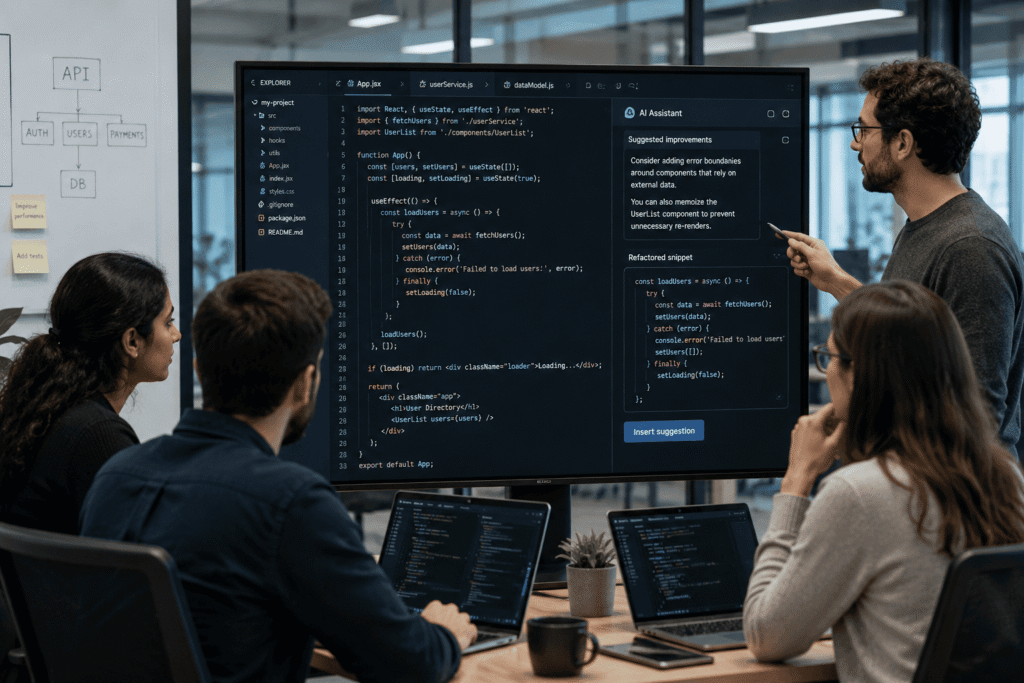
Large language models and AI assisted coding tools have moved from novelty to daily use across the industry. Developers now use AI to draft code, explain unfamiliar sections of a codebase, generate test cases, and summarize documentation. This has not removed the need for engineering judgment. It has changed the starting point for many tasks, so teams spend less time on boilerplate work and more time on decisions that require business context.
The shift is practical rather than dramatic. Teams adopting AI assisted workflows are not building software in a fundamentally new way. They are removing friction from familiar steps of the process.
AI in Software Planning and Requirements
AI tools can help summarize stakeholder input, draft initial requirement documents, and identify gaps in early planning conversations. This speeds up discovery, though defining true business goals still requires direct conversation between our team and the client.
AI in UI UX Design
Design tools now offer AI generated layout suggestions, content variations, and accessibility checks. These accelerate early concepting, but experienced designers still need to align the final product with brand identity and real user behavior.
AI in Code Generation
This is where AI has had the most visible impact. Developers use AI assistants to generate functions, complete repetitive code, and produce boilerplate structures quickly. Generated code still requires review for accuracy, security, and fit within the broader system.
AI in Code Review
AI tools can flag inconsistent patterns, common bugs, and style issues before a human reviewer even looks at a pull request. This does not replace peer review. It gives reviewers a faster starting point.
AI in Software Testing
AI assisted testing tools can generate test cases, identify untested code paths, and support regression testing at a faster pace than manual test writing alone. Quality assurance professionals remain essential for judgment calls about what actually matters to test.
AI in Debugging
AI can help trace errors, suggest likely causes, and summarize stack traces in plain language. This shortens investigation time, particularly in large or unfamiliar codebases.
AI in Software Documentation
Generating and maintaining documentation is one of the more consistently reliable uses of AI today, since it excels at summarizing existing code and producing readable explanations.
AI in Software Security
AI assisted static analysis tools can detect common vulnerability patterns and flag risky code before deployment. These tools complement, rather than replace, established security practices such as penetration testing and secure architecture review.
AI in Deployment and Maintenance
AI can support monitoring, anomaly detection, and log analysis after a system goes live, helping teams catch issues earlier during ongoing maintenance.
Developer productivity gains from AI tend to come from removing repetitive work rather than replacing skilled effort. Writing standard functions, formatting code, drafting comments, and searching documentation all take less time now. This gives experienced developers more room to focus on architecture, complex problem solving, and business alignment, which is where their expertise adds the most value.
Benefits of AI in Software Development
| AI Benefit | Business Impact |
|---|---|
| Faster coding of routine tasks | Shorter development cycles |
| Automated test generation | Improved coverage and earlier bug detection |
| AI assisted documentation | Easier onboarding and system handoffs |
| AI supported code review | Fewer overlooked issues before release |
| AI assisted debugging | Reduced time spent diagnosing problems |
Actual results vary based on project complexity, team experience, and how well AI tools are integrated into existing workflows.
AI Software Development vs Traditional Software Development
| Aspect | Traditional Development | AI Assisted Development |
|---|---|---|
| Coding speed | Manual, line by line | Assisted drafting and completion |
| Testing | Primarily manual test writing | AI generated tests plus manual review |
| Documentation | Often delayed or skipped | Generated alongside development |
| Code review | Fully manual | AI flagged issues plus human review |
| Debugging | Manual investigation | AI assisted trace analysis |
No, not in any meaningful sense today. AI can generate code, but it does not understand business context, user needs, regulatory requirements, or the long term consequences of architectural decisions the way an experienced developer does. AI generated code can also contain errors, security gaps, or logic that looks correct but fails under real conditions.
The realistic picture is collaboration. AI handles pattern based, repetitive work well. Developers remain responsible for architecture, security decisions, stakeholder communication, and the judgment calls that determine whether software actually solves the right problem.
AI generated code can contain subtle bugs, outdated patterns, or security gaps that are not obvious at first glance. Models can also produce confident sounding but incorrect suggestions, sometimes called hallucinations, which is why review remains essential. Other considerations include intellectual property questions around training data, data privacy on sensitive codebases, and the need for clear governance around which tools employees can use.
Expert Tip
Treat AI generated code the same way you would treat code from a junior developer. It can be useful and fast, but it still needs review from someone with experience before it goes into production.
Successful adoption follows a similar pattern across organizations. It starts with a clear understanding of where AI can realistically help, a small pilot project rather than a full rollout, then expansion once the team has confidence in the results.
AI Adoption Roadmap
- Awareness: Understand what AI can and cannot do for your specific software needs.
- Assessment: Identify which parts of your development process involve repetitive or pattern based work.
- Pilot Project: Test AI tools on a limited, low risk project.
- Team Adoption: Train developers on effective and responsible use of AI tools.
- Process Integration: Build AI assisted steps into standard workflows.
- Governance: Establish policies for code review, data privacy, and tool usage.
- Scaling: Expand successful practices across additional teams and projects.
- Continuous Improvement: Review outcomes regularly and adjust as tools and needs evolve.
Consider the following questions to gauge how ready your organization is for AI assisted software development.
- Does your business have clearly defined software requirements
- Does your organization already use cloud based systems
- Do your developers have experience working with AI assisted tools
- Are security policies established
- Does your organization have quality assurance processes in place
- Are employees spending significant time on repetitive development tasks
- Do you have clear data governance practices
- Is leadership prepared to support responsible AI adoption
If you answered yes to most of these, your organization is likely ready for a focused pilot project. If you answered yes to only a few, it may be worth strengthening foundational practices such as documentation and quality assurance first.
AI can reduce time spent on certain repetitive tasks, which can influence overall project timelines and cost. However, actual savings depend heavily on project complexity, the quality of implementation, and how well AI tools are integrated into a team’s existing process. We avoid promising specific percentage savings, since results differ significantly from one project to another.
| Cost Factor | Consideration |
|---|---|
| Tooling and licensing | Ongoing cost for AI assisted development platforms |
| Training | Time investment to bring developers up to speed |
| Review overhead | Human review remains necessary for AI generated output |
| Project complexity | Highly custom systems see less uniform time savings |
| Long term maintenance | Well documented AI assisted code can ease future updates |
Look for a technology partner that treats AI as one part of a broader engineering discipline rather than the entire pitch. Ask how they review AI generated code, how they handle data privacy, what quality assurance processes they follow, and whether they can explain both the strengths and limitations of the tools they use. A partner who is transparent about where AI falls short is generally more trustworthy than one who presents it as a solution for everything.
Our team approaches AI as a way to strengthen proven software development practices, not replace them. Whether you are exploring an AI powered feature, modernizing legacy software, or building a new application from the ground up, our experts can help you identify where AI genuinely adds value for your specific goals.
- Adopting AI tools without a governance policy
- Assuming AI generated code does not need review
- Choosing tools based on trends rather than project needs
- Skipping testing because code was AI generated
- Underinvesting in training
- Ignoring data privacy when using AI on proprietary code
Current trends point toward more capable AI assisted coding tools, wider use of AI agents for defined tasks, more automated testing pipelines, and continued growth in natural language interfaces for development. These are extensions of capabilities already in use today rather than entirely new territory. We stay focused on what is realistically achievable now while tracking emerging tools that may offer practical value as they mature.
Frequently Asked Questions
Key Takeaways
Summary
- AI is genuinely changing software development, particularly in coding, testing, documentation, and review.
- The technology works best as a support tool guided by experienced professionals, not as a replacement for them.
- Risks such as security gaps and inaccurate output make human review essential.
- Successful adoption starts small, with a clear pilot project and defined governance.
- The right technology partner will be honest about both the strengths and limitations of AI.
AI has become a practical part of modern software development, and businesses that understand where it genuinely helps are positioned to build better software more efficiently. At the same time, the fundamentals have not changed. Strong architecture, security, thorough testing, and real understanding of business needs still come from experienced professionals. Organizations that get the most value from AI use it deliberately, with clear governance and skilled people guiding the process.
If you are exploring how AI could fit into a new software project, or if you want a clear eyed assessment of where it makes sense for your existing systems, our team is ready to talk through your goals. Visit our Home page to learn more about our approach.
Ready to Build Your Digital First Strategy?
From custom software and web development to AI solutions and business automation, Devloria helps businesses become future ready. Let's talk about what a realistic roadmap looks like for you.
Schedule a Consultation